
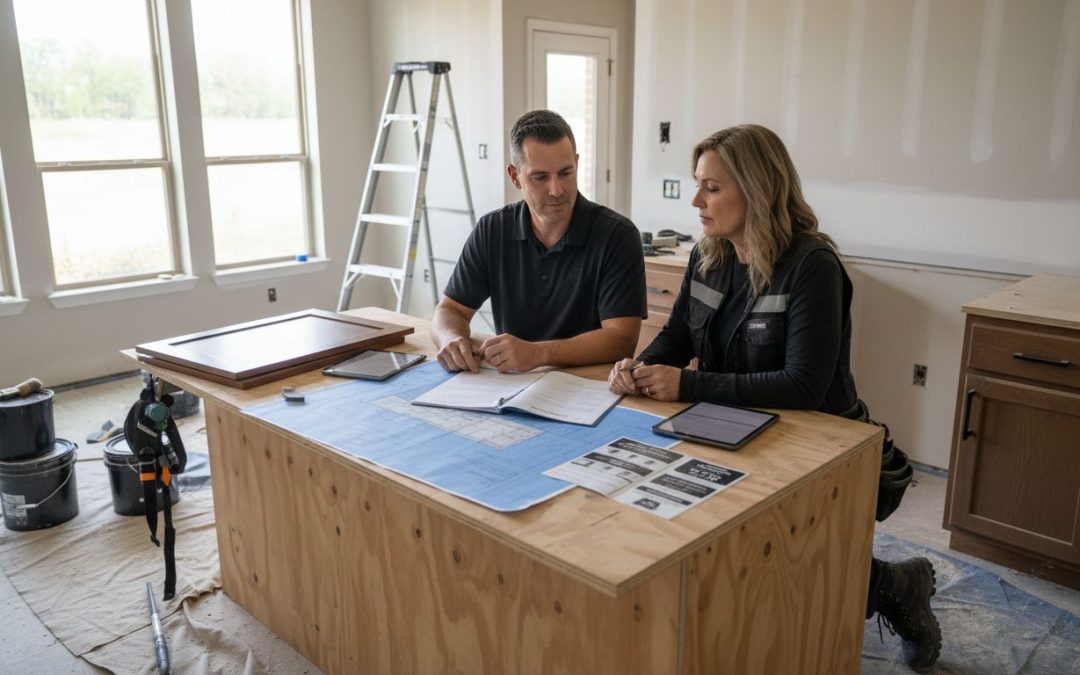
Over half of home renovation disputes stem from unclear contracts and mismatched expectations. Whether you are planning a kitchen update or a full home transformation, laying the legal groundwork is crucial for a smooth project. A well-crafted remodeling contract not only defines responsibilities and protects your investment but also brings peace of mind by eliminating guesswork from the start. Understanding what goes into this document helps every Dallas Fort Worth homeowner set the stage for a successful renovation.
Table of Contents
- Defining A Remodeling Contract And Its Purpose
- Types Of Remodeling Contracts And Their Differences
- Essential Clauses And Legal Requirements
- Roles, Rights, And Responsibilities Of Parties Involved
- Common Risks, Mistakes, And How To Avoid Them
Key Takeaways
| Point | Details |
|---|---|
| Importance of Remodeling Contracts | A remodeling contract legally establishes the project scope, expectations, and obligations between homeowners and contractors, providing protection and clarity for both parties. |
| Types of Contracts | Understanding different contract types (e.g., Lump Sum, Cost-Plus) is essential for aligning project needs with appropriate financial structures and risk management strategies. |
| Key Legal Clauses | Essential elements such as scope of work, payment terms, and warranties must be clearly defined in the contract to prevent misunderstandings and ensure project success. |
| Risk Management | Proactive strategies, including budget planning and clear communication, are critical to mitigate common risks like budget overruns and quality issues during renovation projects. |
Defining a Remodeling Contract and Its Purpose
A remodeling contract is a legally binding document that establishes the formal agreement between a homeowner and a construction professional, outlining the specific details, expectations, and obligations for a renovation project. According to Wikipedia, a construction contract fundamentally serves as a legally binding agreement that details the scope of work, associated risks, project duration, specific duties, required deliverables, and critical legal rights for both the contractor and property owner.
At its core, a remodeling contract functions as a comprehensive roadmap that transforms your home improvement vision into a structured, actionable plan. Eric.ed.gov research highlights that such contracts typically involve professional translation of specific requirements into precise drawings and specifications, which contractors then use to assemble materials and execute the planned renovation.
The primary purpose of a remodeling contract extends far beyond mere paperwork – it provides crucial protection and clarity for both parties. Key elements typically include:
- Detailed project scope and specific work to be completed
- Precise cost breakdown and payment schedule
- Expected project timeline and milestone dates
- Materials specifications and quality standards
- Warranty information and potential contingencies
- Legal provisions addressing potential disputes or changes
By establishing these clear parameters upfront, a well-crafted remodeling contract helps prevent misunderstandings, reduces potential conflicts, and ensures both the homeowner and contractor have a shared understanding of project expectations. For homeowners in the Dallas Fort Worth area seeking comprehensive renovation services, understanding the nuances of a remodeling contract is your first step toward a successful home improvement journey.
Want to dive deeper into planning your perfect renovation? Check out our guide on home remodel planning for more insights into creating a smooth, stress-free remodeling experience.
Types of Remodeling Contracts and Their Differences
Remodeling contracts are not one-size-fits-all solutions. According to Procore, multiple contract types exist, each designed to address different project needs and risk management strategies. Understanding these variations is crucial for homeowners planning renovation projects, as the right contract can significantly impact project outcomes and financial expectations.
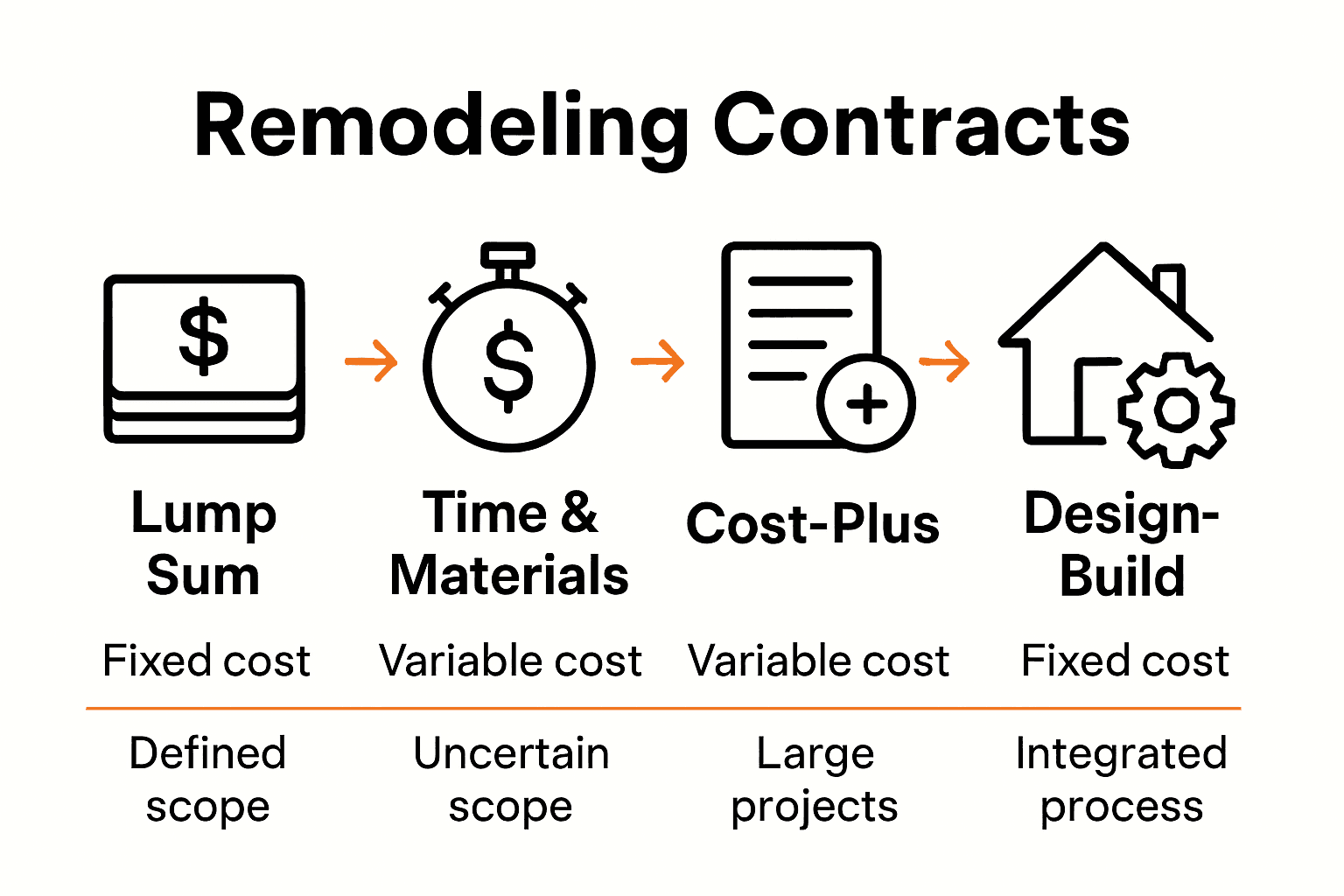
Lump Sum Contracts represent the most straightforward approach, where a fixed total price is established for the entire project. This contract type provides clear financial expectations upfront, making budgeting more predictable. Homeowners know exactly what they’ll spend, and contractors have a defined scope of work.

Mastt highlights another important contract variant: the design-build contract, which uniquely combines design and construction under a single agreement. This approach streamlines communication and project delivery, reducing potential miscommunications between design and construction phases.
Key contract types include:
Here’s how the main remodeling contract types compare:
| Contract Type | Cost Structure | Best For | Key Advantages |
|---|---|---|---|
| Lump Sum | Fixed total price | Well-defined projects | Predictable cost Low risk for homeowner |
| Time and Materials | Actual time & costs | Evolving or complex jobs | Flexibility Transparent expenses |
| Cost-Plus | Costs plus %/fee | Uncertain project scope | Transparent pricing Adjusts to changes |
| Design-Build | Combined design/build | Fast-track & streamlined | Single contact Faster delivery |
-
Lump Sum (Fixed Price) Contract
- Predetermined total project cost
- Minimal financial risk for homeowner
- Best for well-defined projects
-
Time and Materials Contract
- Billing based on actual time and material costs
- Flexible for complex or evolving projects
- Includes predetermined markup percentage
-
Cost-Plus Contract
- Contractor receives project costs plus additional percentage
- Transparent pricing structure
- Ideal for projects with uncertain scope
-
Design-Build Contract
- Single entity responsible for design and construction
- Simplified project management
- Faster project completion
Choosing the right contract depends on your specific project complexity, budget, and comfort with potential financial variations.
 For Dallas Fort Worth homeowners seeking expert guidance, our contractor hiring guide can help you navigate these critical decisions and select the most appropriate contract for your home improvement needs.
Essential Clauses and Legal Requirements
A comprehensive remodeling contract isn’t just paperwork – it’s a critical legal shield protecting both homeowners and contractors. UCOP emphasizes that construction contracts must include specific documentation that allows for uniform bid comparison and transparent selection standards, ensuring fairness and clarity from the project’s inception.
Key Legal Clauses form the backbone of a robust remodeling contract. These essential components go beyond simple project descriptions and create a comprehensive framework for project execution. Critical elements include detailed scope of work, precise payment schedules, explicit material specifications, comprehensive insurance requirements, and clear dispute resolution mechanisms.
Understanding the legal landscape is crucial. ICNL highlights that remodeling activities are often subject to specific government regulations that can impact project recognition and potential tax implications. This means homeowners must be vigilant about contractual details.
Essential contract clauses every homeowner should insist upon include:
-
Scope of Work
- Detailed description of all planned renovations
- Specific materials to be used
- Exact areas of the home to be remodeled
-
Payment Terms
- Clear payment schedule
- Milestone-based payments
- Contingency for unexpected expenses
-
Timeline and Completion
- Projected start and end dates
- Penalties for project delays
- Conditions for timeline extensions
-
Warranty and Guarantees
- Length of workmanship warranty
- Coverage for materials and labor
- Process for addressing post-project issues
-
Termination Conditions
- Circumstances allowing contract cancellation
- Financial implications of early termination
- Compensation mechanisms
Navigating these legal intricacies can feel overwhelming, which is why our comprehensive home renovation guide offers detailed insights to help Dallas Fort Worth homeowners understand every aspect of their remodeling journey.
Roles, Rights, and Responsibilities of Parties Involved
A successful remodeling project hinges on clearly defined roles and expectations for each party involved. The two primary participants – the homeowner and the contractor – must establish a transparent partnership where responsibilities, rights, and boundaries are explicitly outlined in the remodeling contract.
Homeowner Responsibilities encompass more than simply providing financial compensation. Homeowners must actively participate by providing clear project vision, maintaining open communication, ensuring timely decision-making, and granting contractors reasonable access to the renovation space. This includes preparing the work area, removing valuable or fragile items, and being available to answer questions or make critical design choices throughout the project.
Contractors carry significant legal and professional obligations. Their responsibilities extend far beyond physical construction, requiring comprehensive project management, adherence to building codes, obtaining necessary permits, maintaining worker safety, delivering quality workmanship, and managing subcontractors. They must provide detailed documentation, maintain transparent communication, complete work within agreed timelines, and address any issues that arise during the renovation process.
Key responsibilities for each party include:
Homeowner Responsibilities:
- Provide clear project specifications and expectations
- Secure necessary approvals from homeowners association or local authorities
- Make timely design and material selections
- Ensure financial commitments are met
- Maintain open and responsive communication
Contractor Responsibilities:
- Develop comprehensive project plan
- Obtain required permits and licenses
- Manage project timeline and milestones
- Ensure quality of materials and workmanship
- Maintain site safety and cleanliness
- Provide regular progress updates
- Address and resolve any construction issues
Understanding these intricate roles helps prevent misunderstandings and establishes a foundation for a successful renovation. For Dallas Fort Worth homeowners seeking expert guidance through this complex process, our contractor hiring guide offers invaluable insights into building a productive partnership with your remodeling professional.
Common Risks, Mistakes, and How to Avoid Them
Remodeling projects are complex undertakings fraught with potential pitfalls that can derail even the most carefully planned renovation. ProcrewSchedule highlights that different contract types inherently carry unique risks, with certain approaches like unit price contracts potentially leading to payment delays and challenging final cost forecasting.
Budget Overruns represent the most common and potentially devastating risk in home renovation. Procore warns that cost-plus contracts, while offering transparency, require meticulous cost estimation and continuous monitoring to prevent financial spiraling. Homeowners must establish clear contingency funds and maintain rigorous financial tracking throughout the project.
Risks can emerge from multiple fronts, demanding comprehensive strategic planning. Understanding these potential challenges allows homeowners to implement proactive mitigation strategies that protect their investment and maintain project momentum.
Common Risks and Strategic Mitigation Approaches:
Financial Risks:
- Inadequate initial budget planning
- Unexpected structural complications
- Material price fluctuations
- Scope creep and unplanned modifications
Communication Risks:
- Misaligned expectations
- Inadequate project documentation
- Unclear change order processes
- Poor contractor-homeowner communication
Structural and Quality Risks:
- Substandard workmanship
- Non-compliance with local building codes
- Improper material selection
- Incomplete or incorrect project specifications
Mitigation Strategies:
- Conduct thorough contractor background checks
- Develop comprehensive, detailed contract
- Establish clear communication protocols
- Create realistic contingency budgets (15-20% of total project cost)
- Maintain detailed documentation of all discussions and agreements
Navigating these complex dynamics requires knowledge and preparation. For Dallas Fort Worth homeowners seeking comprehensive guidance, our contractor hiring guide provides invaluable insights into building a successful, risk-managed renovation experience.
Secure Your Remodeling Success with a Clear Contract and Trusted Experts
Understanding every detail of your remodeling contract is crucial to avoid costly surprises and stress during your home renovation. The article highlights common pitfalls like unclear scopes, budget overruns, and miscommunication that can turn your dream project into a nightmare. At Astrotech Construction, we specialize in guiding Dallas Fort Worth homeowners through every step of their remodeling journey. We help you establish a solid contract that clearly defines your project scope, timeline, costs, and warranty to protect your investment and peace of mind.
Ready to move forward confidently? Discover how our expert team partners with you to create transparent agreements and deliver quality workmanship on time and within budget. Visit our home remodeling services page to learn more. Take control of your renovation today by contacting us at Astrotech Construction for a personalized consultation and expert advice on your remodeling contract and project planning.
Frequently Asked Questions
What is a remodeling contract?
A remodeling contract is a legally binding document that defines the agreement between a homeowner and a contractor regarding the details, expectations, and obligations of a renovation project.
What are the key elements of a remodeling contract?
Key elements typically include the project scope, cost breakdown, payment schedule, project timeline, materials specifications, warranty information, and legal provisions for disputes or changes.
What are the different types of remodeling contracts?
Different types of remodeling contracts include Lump Sum, Time and Materials, Cost-Plus, and Design-Build contracts, each tailored for specific project needs and risk management strategies.
Why is a remodeling contract important for homeowners?
A remodeling contract is essential as it provides protection and clarity for both the homeowner and the contractor, helping prevent misunderstandings and reducing potential conflicts by establishing clear expectations upfront.
Recommended
- Complete Guide to Remodeling Consultation Services – Astrotech Construction
- How to Plan a Home Remodel for Stress-Free Results – Astrotech Construction
- How to Estimate Remodeling Costs for Any Project – Astrotech Construction
- Complete Guide to Why Renovate Your Home – Astrotech Construction
- Pest Control During Renovations – Pest Control Van Alstyne, TX – Pestico Pest Control