

Every Dallas-Fort Worth project manager knows that overseeing construction is far more than just reading blueprints or making schedules. Success depends on how well you coordinate complex projects, align contractors, and manage both budgets and timelines across residential and commercial renovations. Stepping into this role means becoming the central force that turns bold architectural plans into solid, high-quality spaces while balancing expectations and solving unexpected problems. Construction project management is about leading teams, ensuring compliance, and keeping every stakeholder informed from start to finish.
Table of Contents
- Defining The Project Manager’s Role In Construction
- Key Responsibilities In Renovation Projects
- Essential Skills For Construction Project Managers
- Managing Risks And Legal Compliance On Site
- Building Strong Client And Team Relationships
Key Takeaways
| Point | Details |
|---|---|
| Role of Project Managers | Construction and renovation project managers are pivotal in transforming plans into reality by managing resources, timelines, and team dynamics effectively. |
| Core Responsibilities | Key tasks include budget management, schedule coordination, and ensuring quality control, crucial for project success. |
| Essential Skills | A successful project manager must develop technical proficiency while honing leadership and communication skills to facilitate teamwork and problem resolution. |
| Risk Management | Implementing proactive risk management strategies is vital for legal compliance and safeguarding projects against potential challenges. |
Defining the Project Manager’s Role in Construction
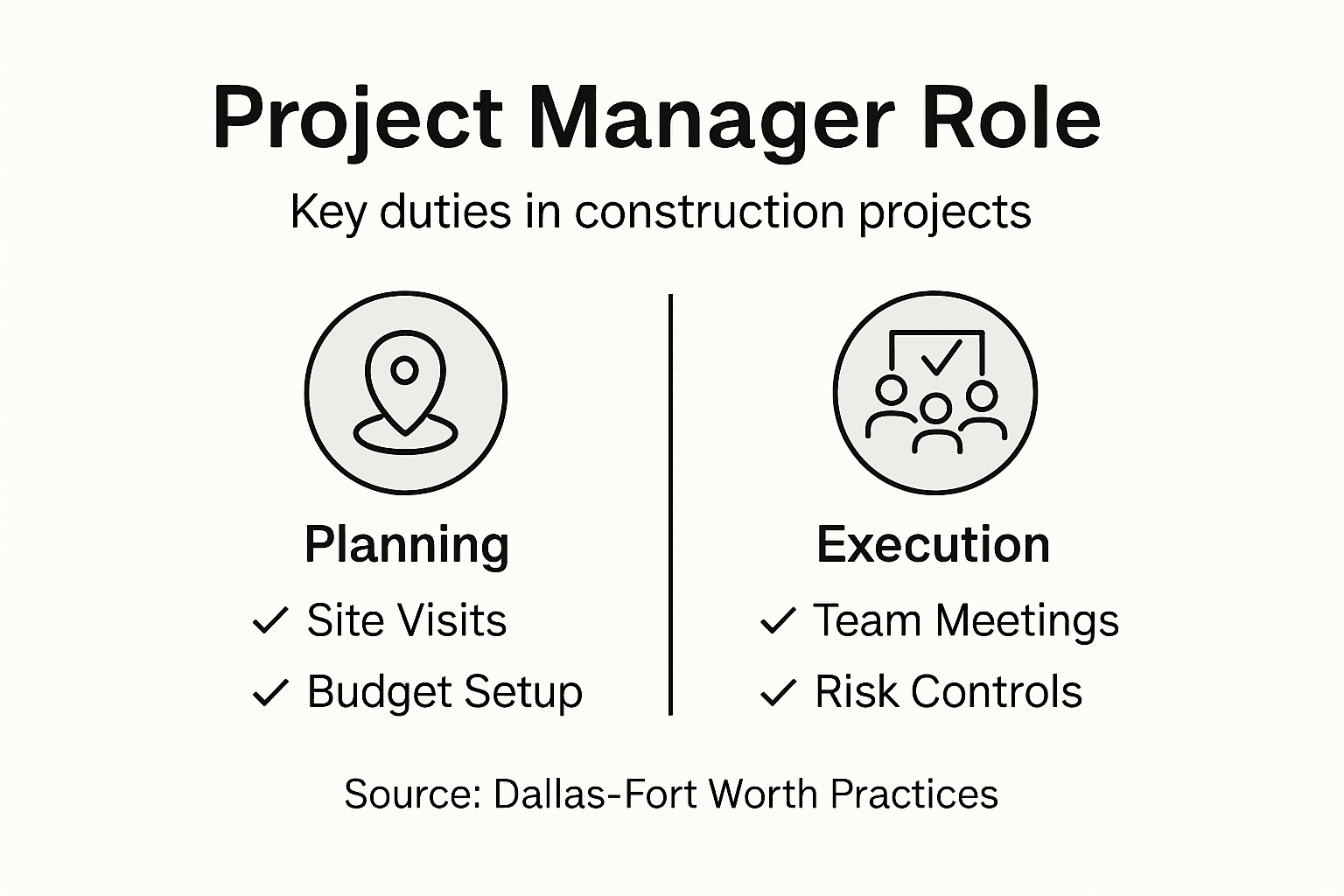
A construction project manager serves as the critical orchestrator who transforms architectural blueprints into tangible realities across residential and commercial renovation projects. By managing complex networks of resources, personnel, and expectations, these professionals ensure that every construction initiative meets precise specifications while navigating numerous interdependent challenges.
According to comprehensive project management research, a construction project manager’s responsibilities encompass several core domains:
- Budget Management: Tracking financial resources and preventing cost overruns
- Schedule Coordination: Ensuring timely project completion
- Team Leadership: Directing contractors, subcontractors, and on-site personnel
- Quality Control: Maintaining rigorous performance standards
- Risk Mitigation: Identifying and addressing potential project complications
The strategic role involves more than simple supervision. Project managers must integrate sustainable development principles while balancing environmental, economic, and social considerations throughout the construction lifecycle. This holistic approach requires exceptional communication skills, technical knowledge, and the ability to make rapid, informed decisions under dynamic conditions.
Successful project managers in the Dallas-Fort Worth construction landscape understand that their role transcends traditional management. They are problem solvers, diplomatic negotiators, and vision translators who convert complex plans into successful building projects. By maintaining clear communication channels, anticipating potential challenges, and proactively managing resources, they transform architectural concepts into functional, high-quality structures.
Pro Tip: Always develop comprehensive communication protocols with all project stakeholders before breaking ground to minimize misunderstandings and streamline project execution.
Key Responsibilities in Renovation Projects
In the dynamic world of construction, renovation project managers play a pivotal role in transforming existing spaces into functional, modern environments. Comprehensive project management research reveals that these professionals must expertly navigate a complex landscape of technical, logistical, and interpersonal challenges throughout the renovation process.
The core responsibilities of a renovation project manager include:
- Project Planning: Developing detailed project roadmaps and timelines
- Budget Management: Creating and maintaining precise financial controls
- Contractor Coordination: Selecting, managing, and monitoring subcontractors
- Quality Assurance: Ensuring work meets industry standards and client expectations
- Safety Compliance: Implementing and enforcing rigorous safety protocols
- Communication Management: Facilitating clear information exchange between all stakeholders
Successful renovation project managers in the Dallas-Fort Worth area must demonstrate exceptional skills in multiple domains. They serve as the critical link between architectural vision and practical execution, translating complex design concepts into tangible improvements. This requires a unique blend of technical knowledge, strategic thinking, and interpersonal communication that goes far beyond traditional management roles.
Effective renovation project management is about anticipating challenges before they emerge and creating proactive solutions that keep the project moving forward seamlessly.
These professionals are responsible for multiple interconnected aspects of the renovation process. From initial site assessments and contract negotiations to final walkthrough and project completion, they maintain comprehensive oversight. Their ability to balance technical precision with diplomatic communication determines the ultimate success of any renovation initiative.
Pro Tip: Develop a comprehensive documentation system that tracks every project detail, ensuring transparency and providing a clear audit trail for all renovation activities.
Here’s how the roles of construction project managers and renovation project managers differ in key areas:
| Aspect | Construction Manager | Renovation Manager |
|---|---|---|
| Project Scope | New builds or full remodels | Updates to existing structures |
| Stakeholder Focus | Owners, architects, city officials | Property owners, tenants |
| Regulatory Concerns | Extensive permitting, zoning laws | Building codes, safety retrofits |
| Typical Challenges | Ground-up coordination, scheduling | Working in occupied spaces, unforeseen issues |
Essential Skills for Construction Project Managers
Construction project managers in the Dallas-Fort Worth area must cultivate a sophisticated blend of technical expertise and interpersonal capabilities. Critical project management skills extend far beyond traditional management approaches, demanding a comprehensive understanding of both technological and human dynamics within construction environments.
The most successful project managers develop a multifaceted skill set that includes:
- Technical Proficiency: Understanding construction methodologies and technologies
- Financial Acumen: Precise budget management and cost control strategies
- Communication Excellence: Clear, consistent stakeholder interactions
- Problem-Solving Skills: Rapid, effective resolution of unexpected challenges
- Leadership Capabilities: Motivating and directing diverse project teams
- Digital Tool Mastery: Leveraging advanced project management software
- Risk Assessment: Identifying and mitigating potential project complications
Technical knowledge forms the foundation of effective project management, but emotional intelligence truly distinguishes exceptional leaders. Project managers must navigate complex interpersonal dynamics, balancing technical requirements with human considerations. They translate complex architectural plans into actionable strategies, ensuring every team member understands their role in the broader project vision.
Successful construction project management is about creating harmony between technical precision and human collaboration.
In the competitive Dallas-Fort Worth construction landscape, project managers who can seamlessly integrate technological proficiency with strategic communication will consistently deliver outstanding results. Their ability to anticipate challenges, adapt to changing conditions, and maintain clear, transparent workflows determines project success.
Pro Tip: Invest consistently in professional development, focusing on emerging technologies and advanced communication techniques to stay ahead in the rapidly evolving construction management field.
Below is a summary of essential soft and technical skills and their impact on project success:
| Skill Type | Example Skill | Value Added to Projects |
|---|---|---|
| Technical | Cost estimating | Prevents overruns and delays |
| Interpersonal | Negotiation | Resolves conflicts efficiently |
| Analytical | Risk assessment | Reduces unexpected setbacks |
| Communication | Progress reporting | Keeps stakeholders informed |
Managing Risks and Legal Compliance on Site
Construction project managers must navigate a complex landscape of legal and safety requirements that extend far beyond traditional project management responsibilities. Advanced risk management strategies have transformed how construction professionals approach potential challenges, integrating proactive identification and mitigation techniques into every stage of project development.
Key risk management strategies for construction sites include:
- Comprehensive Documentation: Maintaining detailed records of all project activities
- Insurance Coverage: Securing appropriate liability and worker protection policies
- Safety Protocol Implementation: Establishing and enforcing rigorous safety standards
- Regulatory Compliance: Staying current with local, state, and federal construction regulations
- Continuous Training: Ensuring all team members understand legal and safety requirements
- Technology Integration: Utilizing digital tools for real-time risk monitoring
Effective legal compliance requires a multifaceted approach that combines meticulous planning with adaptive management techniques. Project managers must develop robust contract management strategies that anticipate potential challenges and create clear mechanisms for resolution.
Legal compliance is not just about avoiding penalties, but about creating a safe, transparent, and professionally managed construction environment.
In the Dallas-Fort Worth construction landscape, successful risk management goes beyond mere compliance. It represents a comprehensive approach to protecting project stakeholders, ensuring worker safety, and maintaining the highest standards of professional integrity. Project managers who master these complex requirements can distinguish themselves as true industry leaders.
Pro Tip: Create a comprehensive risk management checklist that is updated quarterly, incorporating the latest regulatory changes and industry best practices.
Building Strong Client and Team Relationships
Successful construction project management hinges on the delicate art of building powerful interpersonal connections that transcend traditional professional boundaries. Client-contractor relationship dynamics reveal that trust, communication, and mutual respect are the foundational elements of any successful construction initiative.
Key strategies for cultivating robust relationships include:
- Transparent Communication: Regular, clear, and honest updates
- Active Listening: Understanding client and team member perspectives
- Consistent Reliability: Meeting commitments and delivering on promises
- Proactive Problem-Solving: Addressing challenges before they escalate
- Empathetic Engagement: Showing genuine care for project stakeholders
- Collaborative Decision-Making: Involving team members in critical choices
In the competitive Dallas-Fort Worth construction landscape, maintaining workplace relationships requires more than superficial interactions. Project managers must develop a nuanced approach that balances professional expertise with emotional intelligence, creating an environment of mutual respect and shared goals.
Exceptional relationships are built on trust, transparency, and a genuine commitment to shared success.
Effective relationship management extends beyond mere communication. It involves creating a collaborative ecosystem where clients feel heard, team members feel valued, and project objectives remain the central focus. Successful project managers act as bridge builders, connecting diverse stakeholders through clear communication, consistent performance, and unwavering professional integrity.
Pro Tip: Schedule monthly relationship health check-ins with both clients and team members, using structured feedback mechanisms to continuously improve collaboration and trust.
Elevate Your Construction Project with Expert Management Support
Taking a construction or renovation project from plan to reality involves managing complex challenges like budget control, scheduling, quality assurance, and risk mitigation. This article highlights the critical role a skilled project manager plays in overcoming these pain points and delivering successful outcomes. Whether you face unpredictability in renovation scopes or need seamless coordination among contractors, effective project management ensures your vision translates into a durable, high-quality structure.
At AstroTech Construction, we understand these challenges deeply. Our professional construction and remodeling services in the Dallas-Fort Worth Metroplex combine expert project oversight with hands-on craftsmanship. From full home remodeling to roof replacement and storm damage repair, our team integrates clear communication, stringent quality control, and proactive problem-solving to keep your project on track and on budget.
Are you ready to experience construction management that turns your renovation dreams into reality with confidence and clarity?

Contact AstroTech Construction today to schedule your personalized consultation. Discover how our comprehensive project leadership can transform your residential or commercial renovation into a seamless success story. Start now and build with the assurance of proven expertise guiding every step.
Frequently Asked Questions
What are the main responsibilities of a construction project manager?
Construction project managers are responsible for budget management, schedule coordination, team leadership, quality control, and risk mitigation to ensure successful project completion.
How do renovation project managers differ from construction project managers?
Renovation project managers focus on updates to existing structures and involve property owners and tenants, while construction project managers work on new builds or full remodels and engage with owners, architects, and city officials.
What essential skills do construction project managers need?
Successful construction project managers must possess technical proficiency, financial acumen, communication excellence, problem-solving skills, leadership capabilities, digital tool mastery, and risk assessment skills.
Why is risk management important in construction projects?
Risk management is vital in construction projects to ensure legal compliance, protect stakeholders, maintain safety standards, and anticipate potential challenges, ultimately leading to successful project completion.