
Over 85 percent of american homeowners report feeling overwhelmed when managing home remodeling projects from start to finish. With so many moving parts and high stakes for your investment, understanding effective project management is more than a luxury, it is a necessity. Whether you are organizing a kitchen upgrade or a full-house renovation, knowing how professional coordination can improve timelines, control costs, and deliver top quality offers real peace of mind throughout the process.
Table of Contents
- Defining Project Management In Remodeling
- Key Phases Of Remodeling Projects
- Essential Project Manager Responsibilities
- Cost, Timeline, And Quality Control
- Common Mistakes In Remodeling Management
Key Takeaways
| Point | Details |
|---|---|
| Strategic Project Management | Effective project management in remodeling involves meticulous planning and coordination to ensure smooth renovations with minimal stress. |
| Core Phases of Remodeling | Understanding the key phases—planning, design, procurement, and construction—is essential for a successful renovation. |
| Project Manager Roles | Project managers must oversee budget management, risk mitigation, quality control, and effective communication among stakeholders. |
| Avoid Common Pitfalls | Homeowners should focus on thorough budget planning, clear communication, and professional oversight to avoid typical project management mistakes. |
Defining Project Management In Remodeling
Project management in remodeling represents a strategic approach to planning, executing, and completing home renovation projects with maximum efficiency and minimal disruption. According to National Association of Home Builders, effective project management involves carefully coordinating multiple complex elements to transform your renovation vision into reality.
At its core, project management for remodeling encompasses comprehensive planning, resource allocation, timeline development, budget control, and stakeholder communication. Homeowners benefit from professional project management by experiencing reduced stress, better predictability, and higher quality outcomes. NAR Milwaukee emphasizes that careful preparation through structured project management can significantly minimize unexpected challenges during renovation processes.
Key components of project management in remodeling include:
- Detailed initial assessment of project scope
- Precise budget development and tracking
- Comprehensive timeline creation
- Regular communication protocols
- Risk identification and mitigation strategies
- Quality control checkpoints
Successful project management transforms what could be a chaotic renovation experience into a streamlined, predictable journey. By implementing systematic approaches, homeowners can navigate complex remodeling projects with confidence, ensuring their investment results in the desired transformational outcome.
Key Phases of Remodeling Projects
Successful remodeling projects follow a structured progression of critical phases that transform initial concepts into tangible home improvements. Remodeling Done Right highlights that understanding these sequential stages is fundamental to achieving a smooth, efficient renovation experience.
According to Foraker Group, remodeling projects typically encompass four primary phases:
- Predevelopment and Planning
- Initial concept development
- Preliminary budget assessment
- Project feasibility analysis
- Defining specific renovation goals
- Design and Architectural Phase
- Detailed blueprint creation
- Material selection
- Architectural and design specifications
- Permit and regulatory compliance review
- Procurement and Bidding
- Contractor selection
- Competitive bid evaluation
- Contract negotiations
- Final cost confirmation
- Construction and Implementation
- Site preparation
- Demolition
- Structural modifications
- Finishing work
- Quality assurance inspections
Each phase requires meticulous attention to detail and strategic planning.
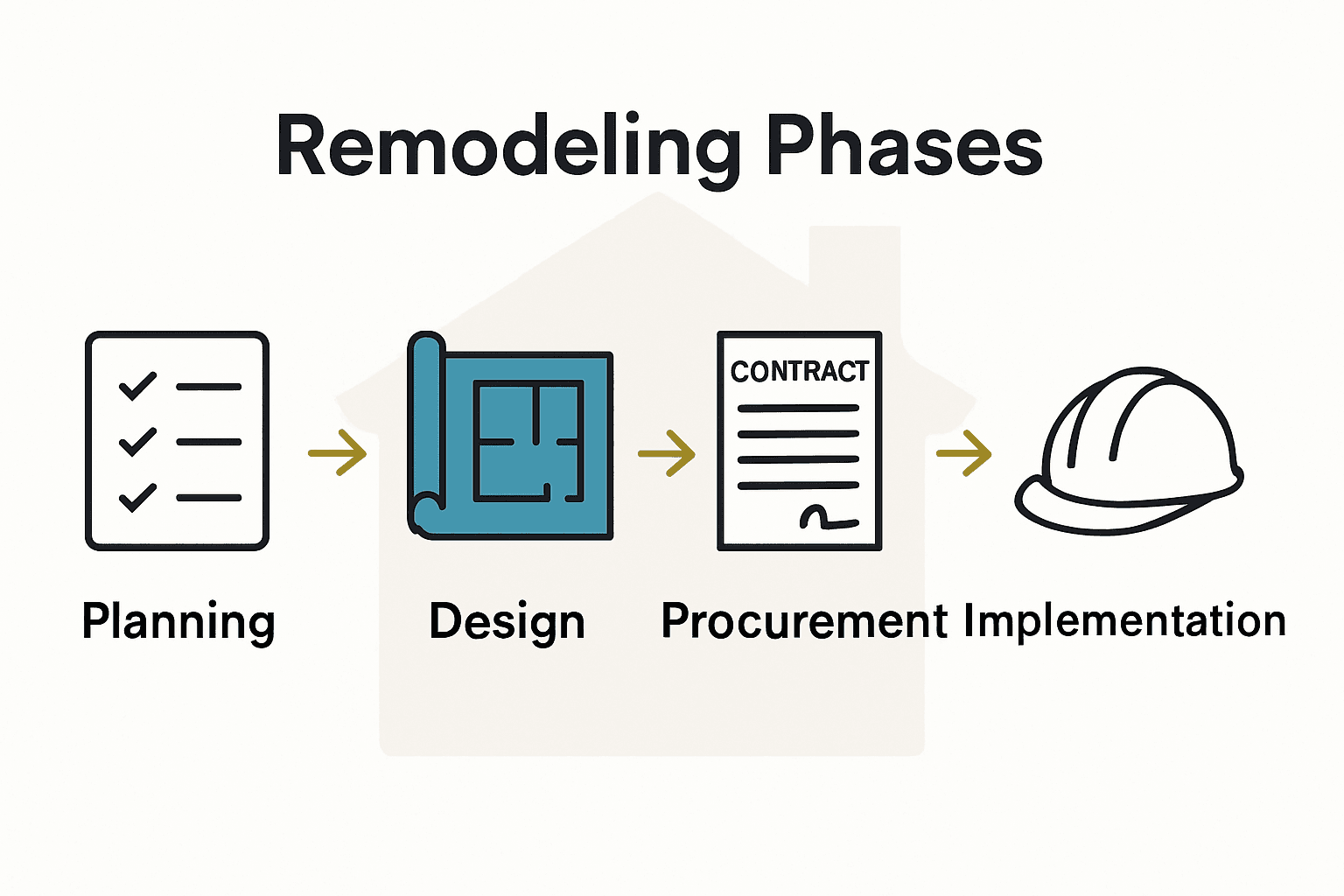 Professional project management ensures seamless transitions between these stages, minimizing potential disruptions and maintaining project momentum.
 How to Plan a Home Remodel Successfully provides homeowners with additional insights into navigating these complex renovation stages with confidence and clarity.
Essential Project Manager Responsibilities
Project managers serve as the critical orchestrators of remodeling projects, ensuring seamless coordination between multiple stakeholders and complex technical requirements. Architecture Courses highlights that their role extends far beyond simple supervision, encompassing comprehensive oversight of every project dimension.
Core responsibilities of project managers in remodeling include:
- Comprehensive project planning
- Budget management and financial tracking
- Risk assessment and mitigation
- Stakeholder communication
- Quality control and standards enforcement
- Timeline development and monitoring
Capital Improvement emphasizes that successful project managers must possess exceptional communication skills, technical knowledge, and the ability to anticipate and resolve potential challenges before they escalate. Their strategic approach involves proactively identifying potential obstacles, developing contingency plans, and maintaining flexible yet structured project frameworks.
Technical expertise combined with strong interpersonal skills distinguishes exceptional project managers. They must navigate complex interactions between contractors, subcontractors, clients, and regulatory bodies while maintaining strict adherence to project specifications, safety standards, and budgetary constraints. This multifaceted role requires a unique blend of analytical thinking, leadership capabilities, and detailed-oriented management to transform renovation concepts into successful, high-quality completed projects.
Cost, Timeline, and Quality Control
Project management in remodeling hinges critically on three interconnected elements: cost management, timeline precision, and uncompromising quality control. These fundamental aspects determine the ultimate success of any renovation project, transforming potential chaos into a structured, predictable process.
ComplexML emphasizes that comprehensive risk management begins with meticulous financial planning. Key strategies for effective cost control include:
- Developing detailed, itemized budgets
- Creating contingency funds (typically 10-20% of total project cost)
- Regular financial tracking and reporting
- Implementing cost-saving value engineering techniques
- Negotiating transparent pricing with contractors
- Monitoring unexpected expense potential
Timeline management requires an equally strategic approach. Successful project managers break down complex renovation processes into measurable milestones, establishing clear expectations and accountability. Quality control serves as the critical framework ensuring that each phase meets predetermined standards. This involves rigorous inspection protocols, material verification, workmanship assessment, and consistent communication between all project stakeholders.
Ultimately, balancing cost, timeline, and quality demands a holistic approach. Homeowners benefit most from project managers who can dynamically adjust strategies, anticipate potential challenges, and maintain flexibility without compromising the project’s core objectives. The goal is not just completing a renovation, but delivering a transformative space that meets both emotional and functional expectations while respecting budgetary constraints.
Common Mistakes in Remodeling Management
Remodeling projects are fraught with potential pitfalls that can derail even the most well-intentioned renovation efforts. NAR Milwaukee highlights that many homeowners inadvertently compromise their project’s success through common management errors that could be easily prevented with proper planning and awareness.
Critical mistakes in remodeling management include:
- Inadequate Budget Planning: Failing to establish a comprehensive and realistic budget with sufficient contingency funds
- Poor Communication: Inconsistent or unclear communication between stakeholders
- Unrealistic Timeline Expectations: Setting overly aggressive or poorly structured project schedules
- Insufficient Documentation: Neglecting to maintain detailed project records and agreements
- Lack of Professional Oversight: Attempting to manage complex renovations without expert guidance
- Incomplete Initial Assessment: Skipping thorough project scope and requirement evaluations
National Association of Home Builders emphasizes that open and transparent communication serves as the most critical prevention strategy against these common management mistakes. Successful project management requires proactive problem identification, continuous stakeholder engagement, and a willingness to adapt strategies as project dynamics evolve.
To mitigate these risks, homeowners should prioritize comprehensive planning, detailed budget tracking, and maintaining flexible yet structured project frameworks. Professional project managers can transform potential challenges into manageable tasks, ensuring that renovation goals are met efficiently and effectively while minimizing stress and unexpected complications.
Transform Your Remodeling Journey with Expert Project Management
Navigating a remodeling project can feel overwhelming without precise planning and clear communication. This guide highlights common challenges like budget surprises, timeline delays, and quality concerns that many homeowners and business owners face. At Astro Tech Construction, we understand the importance of detailed project management. Our team specializes in balancing cost control, timeline accuracy, and quality assurance to turn your renovation goals into reality with confidence and minimal stress.
Why risk costly delays or miscommunication when professional oversight can ensure smooth progress Our experts focus on thorough planning and proactive problem-solving to avoid common pitfalls like inadequate budgeting or incomplete assessments. Discover how our tailored services ranging from full home remodeling to roof replacement align with the key project phases and management responsibilities outlined in the article.
Ready to experience a remodeling process that stays on budget, meets deadlines, and delivers outstanding quality?
Take the first step towards a seamless renovation by visiting Astro Tech Construction today. Get a personalized consultation that puts expert project management at the heart of your home or commercial improvement project. Don’t let your remodeling dream get derailed. Contact us now and build with confidence.
Frequently Asked Questions
What is the role of project management in remodeling?
Project management in remodeling involves planning, executing, and overseeing renovation projects to ensure efficiency, minimize disruption, and achieve the desired results. It encompasses budget control, timeline development, resource allocation, and stakeholder communication.
What are the key phases of a remodeling project?
Remodeling projects typically consist of four main phases: Predevelopment and Planning, Design and Architectural Phase, Procurement and Bidding, and Construction and Implementation. Each phase requires careful management to ensure a smooth renovation process.
What are common mistakes to avoid in remodeling project management?
Common mistakes include inadequate budget planning, poor communication between stakeholders, unrealistic timeline expectations, insufficient documentation, lack of professional oversight, and incomplete initial assessments. These pitfalls can negatively impact the success of the project.
How can homeowners benefit from professional project management in remodeling?
Professional project management helps homeowners reduce stress, improve predictability, and achieve higher quality outcomes. By navigating the complexities of renovation projects, project managers ensure that the homeowner’s vision is realized without unexpected challenges.
Recommended
- Complete Guide to Remodeling Consultation Services – Astrotech Construction
- Why Plan a Remodeling Budget: Complete Guide – Astrotech Construction
- Complete Guide to Renovation vs Remodeling Differences – Astrotech Construction
- How to Plan a Home Remodel for Stress-Free Results – Astrotech Construction