
Choosing a contractor for your Dallas-Fort Worth home renovation can be confusing when every team promises a unique approach. The difference between a traditional process and the integrated design-build method shapes everything from collaboration to project speed. For homeowners who want efficient renovations without losing input or quality, understanding how design-build genuinely works — and its common myths — will help you make confident, informed decisions about your next remodeling project.
Table of Contents
- Design-Build Defined And Common Misconceptions
- Types Of Design-Build Project Delivery Methods
- Step-By-Step Design-Build Process Explained
- Comparing Design-Build To Traditional Methods
- Benefits, Risks, And Cost Considerations
Key Takeaways
| Point | Details |
|---|---|
| Design-Build Overview | This project delivery method integrates design and construction under a single contract, enhancing collaboration and accountability. |
| Common Misconceptions | Homeowners retain control and decision-making power, contrary to beliefs that design-build reduces their involvement. |
| Delivery Models | Various design-build models exist, such as Progressive and Turnkey, allowing flexibility based on project needs. |
| Comparing Methods | Design-Build typically offers faster completion times and more predictable costs compared to traditional Design-Bid-Build approaches. |
Design-Build Defined and Common Misconceptions
Design-build is a project delivery method that brings design and construction together under a single contract. Instead of hiring an architect, waiting months for plans, then hiring a contractor separately, you work with one team that handles both phases. This integrated approach creates a streamlined process where designers and builders collaborate from day one, sharing responsibility for the project’s success.
The method comes in various forms depending on your project’s needs. Engineer-led design-build works well for technically complex projects, while developer-manager approaches suit others. Progressive design-build models allow you to begin construction on certain phases while design continues on others. This flexibility means your Dallas-Fort Worth renovation doesn’t have to follow a rigid one-size-fits-all process.
Now for the misconceptions that often steer homeowners away from this approach. Many believe design-build means you lose control as the homeowner. The opposite is true. You remain actively involved throughout the entire process, collaborating with the combined team on decisions. Some worry that having one company handle both design and construction reduces competition or quality. Actually, design-build creates competition based on value and track record, not just lowest price. Builders and designers working together from the start tend to innovate more effectively because they’re problem-solving as a unit rather than throwing plans over a wall and hoping for the best.
Another common myth is that design-build sacrifices design flexibility. The collaborative nature actually enhances it. When your designer understands construction constraints and costs from the beginning, they create solutions that work beautifully and stay within budget. You’re not stuck with a design that’s impossible or prohibitively expensive to build. For kitchen remodeling or bathroom upgrades in the Metroplex, this means your vision gets refined into something practical without compromising aesthetics.
Pro tip: When interviewing design-build firms in your area, ask them to explain which delivery model they typically use and why it fits your project. The right company will discuss options rather than pushing a single approach.
Types of Design-Build Project Delivery Methods
Design-build isn’t a one-size-fits-all approach. Several variations exist, each structured to handle different project complexities and owner preferences. Understanding these types helps you recognize which model makes sense for your renovation in the Dallas-Fort Worth area.
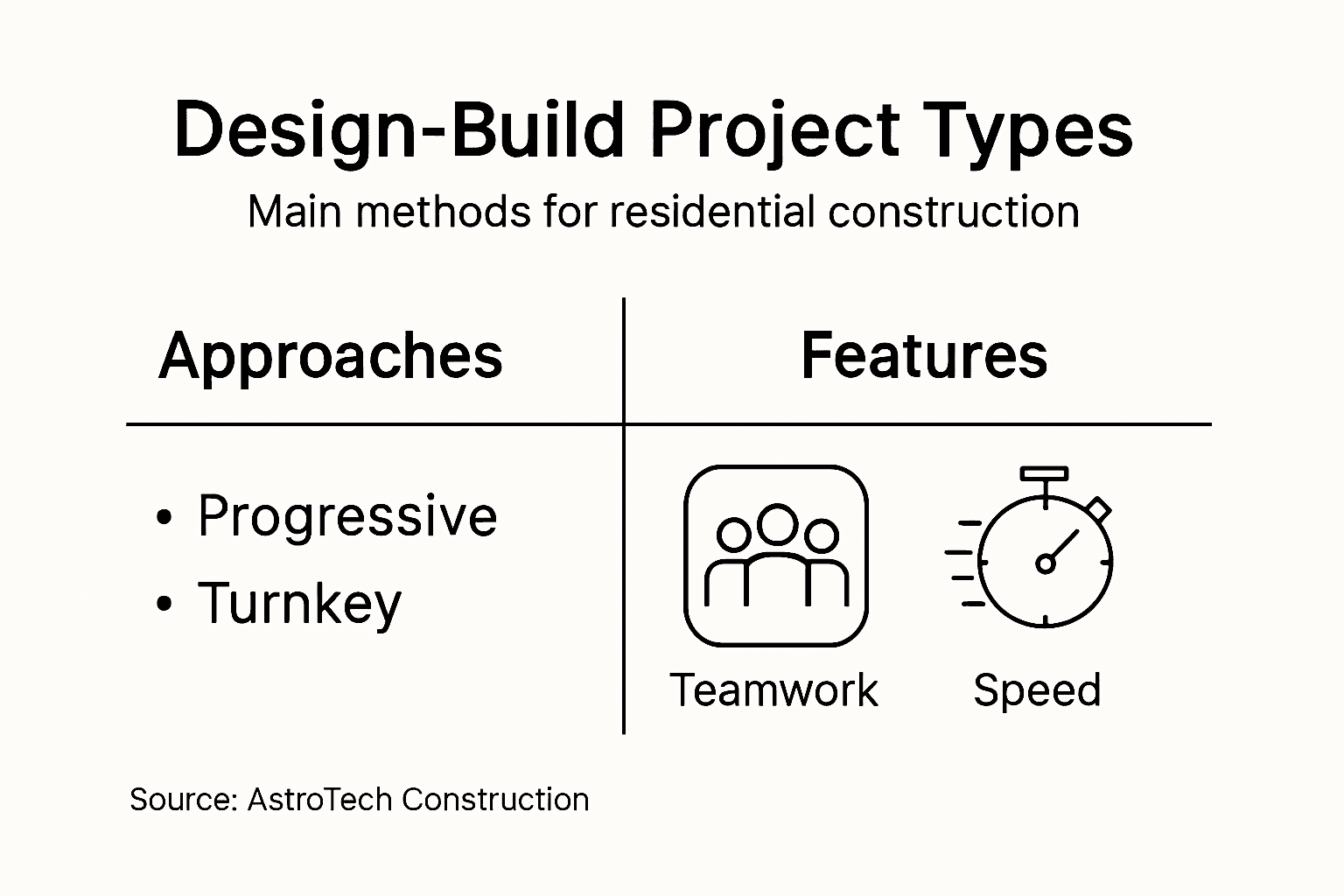
Progressive Design-Build is popular for residential renovations because it lets you start construction while design work continues on remaining phases. Imagine beginning your kitchen remodeling while the designer finalizes bathroom plans. This approach accelerates your timeline and lets you make adjustments based on what you see during construction. It also manages cash flow better since you’re not paying for everything upfront.
Turnkey Design-Build is the opposite end of the spectrum. You hire one firm to handle the complete project from concept to completion. The firm assumes responsibility for design, permitting, construction, and final delivery. This works beautifully for homeowners who want minimal involvement and maximum certainty. You get a finished product that meets specifications, and the contractor bears the financial and schedule risks.
Integrated Project Delivery, sometimes called IPD, brings in additional stakeholders like subcontractors and suppliers early in the design phase. While less common for residential work, it creates the most collaborative environment possible. Everyone sits at the table from day one, sharing information and solving problems together. This reduces conflicts and rework.
There’s also the Design-Build with CM at Risk model, where a construction manager works alongside designers during planning to estimate costs and manage risks before construction starts. This hybrid approach gives you cost certainty while maintaining design flexibility. Different project delivery methods suit different scenarios, but design-build in its various forms consistently outperforms traditional Design-Bid-Build methods for residential projects because it creates accountability and collaboration rather than separation between teams.
The key difference across all these variations is timing and involvement. Some models get you into construction faster. Others give you more control over the final design. Some shift risk to the contractor. Others share it. Your project’s scope, budget, and timeline should guide which type serves you best.
Here’s an overview of common design-build delivery models and when they’re most suitable:
| Delivery Model | Best For | Key Benefit |
|---|---|---|
| Progressive | Multi-phase renovations | Flexible changes during construction |
| Turnkey | Owners seeking simplicity | Minimal involvement, clear timeline |
| Integrated Project Delivery | Complex or collaborative projects | Involvement of all stakeholders early |
| Design-Build with CM at Risk | Projects needing cost certainty | Professional risk management and early cost input |
Pro tip: Ask your design-build contractor which delivery model they typically recommend for projects like yours and why, rather than assuming they’ll use the same approach for every homeowner.
Step-by-Step Design-Build Process Explained
The design-build process unfolds in distinct phases, though what makes it different from traditional construction is how these phases overlap and interact. You don’t wait for complete drawings before construction begins. Instead, teams work simultaneously, sharing information and making adjustments in real time. Here’s how it actually flows from start to finish.
Phase 1: Site Selection and Project Planning comes first. You identify the property and define what you want to accomplish. Your design-build team evaluates the site for feasibility, existing conditions, and constraints. During this phase, you establish your budget and timeline. The team develops a preliminary project plan that aligns your design vision with realistic costs and schedules. This upfront clarity prevents the budget surprises many homeowners face with traditional construction.
Phase 2: Team Selection and Procurement involves choosing your design-build firm and specialized contractors. The best firms use requests for qualifications and proposals (RFQs and RFPs) to identify subcontractors and suppliers who have proven experience and share the project vision. This isn’t just about price. It’s about finding partners whose work quality matches your standards and whose communication style fits your preferences. A remodeling company that conducts thorough project scope planning from the start ensures every team member understands expectations.
Phase 3: Design and Construction Overlap is where design-build creates its advantage. The design team produces drawings while the construction team procures materials and prepares the site. Builders give designers real time feedback on constructability and cost. Designers get input from the field about what’s working and what needs adjustment. The design-build process minimizes redesigns because everyone collaborates rather than works in silos. For a Dallas-Fort Worth kitchen or bathroom renovation, this means if the designer specifies something that costs more than expected, you discover this while adjustments are still easy and affordable.
Phase 4: Construction and Closeout completes the physical work. Your design-build team coordinates trades, manages the schedule, and handles quality inspections. When construction finishes, the unified team conducts final walkthrough, addresses any punch list items, and transfers ownership to you. One firm bears responsibility for the entire outcome, which creates powerful accountability.
The timeline advantage is real. Design-build projects typically complete 20 to 30 percent faster than traditional methods because phases overlap instead of following sequentially.
Pro tip: During the planning phase, clearly document your priorities (speed, design flexibility, or cost certainty) so your design-build team knows which decisions to optimize for throughout the project.
Comparing Design-Build to Traditional Methods
Most homeowners in the Dallas-Fort Worth area have heard of the traditional approach to construction. You hire an architect to design your project, then send those plans out for competitive bids, then hire the lowest bidder to build. It’s called Design-Bid-Build, and it’s been the standard for decades. But design-build works fundamentally differently, and understanding those differences helps you choose the right approach for your renovation.

With Design-Bid-Build, design and construction operate as completely separate phases. Your architect finishes the plans entirely before any contractor sees them. Then contractors bid based on those complete drawings. This separation offers some advantages. You get clear design control because the architect works for you alone. You also get competitive bidding, which can drive down price. But the sequential timeline creates serious drawbacks. Architects design without construction input, sometimes specifying solutions that are expensive or difficult to build. When contractors encounter problems during construction, they submit change orders, which inflate costs and extend timelines. The original 20 percent budget overrun you thought impossible becomes 35 percent when the architect’s beautiful design meets construction reality.
Design-Build eliminates this separation. Designers and builders work together from day one. The architect understands construction constraints while designing. The builder provides cost feedback while design is still flexible. This unified approach to design and construction reduces change orders because problems get solved during planning, not during construction. You avoid the frustration of discovering mid-project that your beautiful bathroom redesign requires structural changes nobody anticipated.
Here’s the trade off. Design-Bid-Build gives you more control over every design detail because you work directly with an architect who prioritizes your vision. Design-Build requires trust in the integrated team to deliver your vision within the constraints of budget and timeline. With Design-Bid-Build, competitive bidding can lower price, but it often creates adversarial relationships. With Design-Build, one firm bears financial responsibility for the outcome, creating accountability but less shopping around for individual services.
Timeline matters too. Design-Bid-Build typically takes significantly longer because phases don’t overlap. Design-Build compresses timelines by 20 to 30 percent because teams work simultaneously. If you’re eager to move into your renovated kitchen or need your office operational quickly, design-build delivery compresses schedules substantially compared to the linear design-bid-build model.
For residential projects in the Metroplex, design-build works well when you have budget clarity, trust the contractor’s judgment, and value speed. Design-Bid-Build works better if you want maximum design flexibility and prefer competitive price quotes from multiple contractors.
To clarify the main differences between Design-Build and Design-Bid-Build, see the summary below:
| Aspect | Design-Build | Design-Bid-Build |
|---|---|---|
| Contract Structure | Single contract for both phases | Separate contracts for design and construction |
| Team Collaboration | Designers and builders work together | Designers and builders work independently |
| Timeline | Overlapping phases, faster completion | Sequential phases, longer duration |
| Cost Predictability | More accurate budgeting, fewer overruns | Higher chance of change orders and overruns |
| Control Over Design | Shared between owner and team | Full design control with the owner |
| Accountability | Single firm responsible | Split responsibility between architect and builder |
Pro tip: If you choose design-build, define your three non-negotiable design elements at the start. These anchor your vision while allowing flexibility on less critical details, helping the team balance your aesthetic goals with practical constraints.
Benefits, Risks, and Cost Considerations
Design-build isn’t perfect for every situation, but understanding its genuine advantages and real limitations helps you decide if it fits your Dallas-Fort Worth renovation. Let’s look at what actually matters in the financial and practical sides of this approach.
The Primary Benefits
The biggest advantage is accountability. One firm handles design and construction under a single contract. If something goes wrong, there’s no finger-pointing between architect and contractor. You have one entity responsible for delivering your project on time and within budget. This accountability drives collaboration because everyone shares the same financial outcome. When a designer knows the builder will execute their plans, and the builder knows the designer understands construction constraints, they work together instead of against each other.
Cost control improves significantly. With Design-Bid-Build, change orders pile up because architects designed without construction input. With design-build, realistic budgets and schedules emerge from early collaboration between designers and builders. Many design-build firms offer guaranteed maximum price contracts, which means you know your ceiling cost upfront. You won’t discover halfway through your kitchen remodel that the plumbing requires expensive modifications.
Speed matters too. Overlapping design and construction phases compress timelines significantly. While Design-Bid-Build takes nine to twelve months for a major home renovation, design-build typically delivers in six to eight months. For homeowners who need to occupy the space sooner, this timeline compression is genuinely valuable.
The Real Risks and Limitations
Design-build requires more trust from you upfront. You’re committing to a firm before all design details are finalized. If you want to control every aesthetic decision independently, you’ll feel frustrated because the designer optimizes for buildability, not just beauty. You have less ability to shop around for competitive bids from multiple contractors on individual trades.
The firm you select matters enormously. A poorly chosen design-build partner can deliver mediocre results just as easily as a traditional contractor. The integrated structure doesn’t guarantee quality; it only creates accountability for whatever quality you receive.
Cost Realities
Design-build isn’t automatically cheaper. It’s more predictable. You might pay slightly more per square foot than the absolute lowest Design-Bid-Build bid, but you avoid the 15 to 25 percent cost overruns that plague traditional projects. For most homeowners, predictability beats gambling on lowest price. If your budget is absolutely fixed and minimal, design-build’s initial cost might appear higher than a low traditional bid. But if you account for typical change orders in traditional projects, design-build often costs less overall.
Pro tip: Request a guaranteed maximum price contract from your design-build firm and ask how change orders are handled if circumstances require scope adjustments during construction.
Discover How Design-Build Transforms Your Dallas-Fort Worth Renovation Experience
Taking on a home or commercial renovation can feel overwhelming when faced with complex planning, uncertain budgets, and long timelines. This article highlights how the design-build method solves these challenges by offering a single contract solution that integrates design and construction. It addresses the common pain points of unpredictable costs, delayed schedules, and fragmented communication. By choosing this collaborative approach, you gain clearer budget control, faster completion, and a team that is accountable from start to finish.
If you are ready to experience these benefits firsthand, AstroTech Construction specializes in design-build services tailored for the Dallas-Fort Worth Metroplex. From kitchen and bathroom upgrades to full home remodeling, our expert team ensures your vision comes to life efficiently and beautifully while respecting your budget. Explore how our streamlined process and commitment to quality set us apart by visiting our homepage.
Ready to see your renovation dreams become reality with less stress and more certainty
Contact AstroTech Construction today to schedule your consultation. Take the first step toward a smoother renovation powered by design-build expertise that puts you in control without the usual headaches.
Frequently Asked Questions
What is the design-build project delivery method?
Design-build is a project delivery method that combines both design and construction phases under a single contract, allowing for streamlined collaboration and faster project completion.
How does design-build differ from traditional construction methods?
In design-build, designers and builders work together from the start, allowing design flexibility and reducing chances of costly change orders. Traditional methods separate these phases, leading to longer timelines and potential budget overruns.
What are the benefits of using a design-build approach?
The major benefits include increased accountability, improved cost control, faster project timelines, and enhanced collaboration between designers and builders, which can lead to higher quality results.
What should I consider when choosing a design-build firm?
When selecting a design-build firm, consider their experience, the delivery model they use, their approach to project management, and how they handle communication and collaboration throughout the project.